
2026-09-15
FIU Latvia at Kyiv Sanctions Forum: sanctions implementation is a collective effort at EU level
04.08.2026
On 11 May, the Council of the EU adopted sanctions against an additional 16 individuals and seven entities involved in the unlawful deportation and forced transfer of Ukrainian children to Russia. According to the EU, the sanctions target persons and institutions involved in the systematic, unlawful deportation and forced transfer of Ukrainian children, the so-called militarised “re-education”, and unlawful adoption practices. The sanctions apply to Russian officials and politicians, children's centres, youth organisations, and other entities facilitating the integration of Ukrainian children into the Russian system.
On 15 June, the Council of the EU adopted a decision to expand the EU's sanctions lists against Russia. The changes include additions to the lists of natural and legal persons subject to targeted financial sanctions in connection with Russia’s illegal war in Ukraine, Russia’s hybrid threat activities, and human rights violations. Notably, these additions to the sanctions list were adopted outside the EU’s broader sanctions package.
On 21 May, the CJEU delivered a judgment interpreting the obligation to freeze assets under targeted financial sanctions in relation to funds and economic resources transferred by a sanctioned person into a trust. The CJEU ruled that assets transferred into a trust may be regarded as owned or controlled by the sanctioned person ns if that person retains powers enabling them to use, benefit from, dispose of, or otherwise exercise influence over those assets, including the ability to influence decisions made by the trustee in relation to them.
On 11 June, the CJEU dismissed the appeal filed by Russia's National Settlement Depository (NSD) seeking its removal from the EU sanctions list. The CJEU held that an entity's significant role in Russia's financial system and its contribution to the functioning of the Russian state's financial system may constitute sufficient grounds for its inclusion on the EU sanctions list. The Court further clarified that it is not necessary to demonstrate that the entity directly financed Russia's military aggression or specific actions aimed at destabilising Ukraine. Rather, it is sufficient to establish that the entity provides material or financial support to the Russian Government or plays a significant role in the relevant sector. As a result, the CJEU dismissed the appeal and upheld the General Court's judgment confirming that the inclusion of Russia's NSD on the EU sanctions list was justified and should be maintained.
During Q2, FIU Latvia received 359 suspicious transaction reports indicating suspected sanctions violations or attempted sanctions violations. As in Q1, the most common cases in Q2 involved the potential transfer of sanctioned goods to Russia through third countries, the provision of prohibited services to legal entities established in Russia, accounts held with banks included on sanctions lists, and the transportation of cash to Russia. A total of 84 analytical reports concerning potential sanctions violations were submitted to law enforcement authorities and other institutions.
FIU Latvia continues to update the “Frequently Asked Questions” (FAQ) section of its website regarding implementation of sanctions by clarifying existing explanations and adding new information. The updated FAQ section provides explanations on making payments after the end of transitional periods, the application of import bans and transit through the EU, the application of General License, the interpretation of contracts concluded before the imposition of sanctions, trade in goods imported before the imposition of sanctions, as well as restrictions on the provision of management services to legal entities registered in Russia and Belarus.
FIU Latvia has published updated guidelines Assessment of control of designated public officialsThe guidelines have been supplemented in accordance with the definitions included in EU sanctions legislation of “owning a legal person, entity or body” and “controlling a legal person, entity or body”. Although EU institutions had previously provided guidance on the criteria to be considered when assessing ownership and control for the purposes of applying sanctions, these criteria have now been legally established in Regulation (EU) No 269/2014. FIU Latvia’s approach to the assessment of control remains unchanged.
At the end of Q2 of 2026, the following assets owned or controlled by persons included on sanctions lists were frozen in Latvian financial institutions and state registers:
The list of sanctioned persons whose assets have been frozen in Latvia is available here.
During Q2 of 2026:
During Q2 of 2026, Latvian courts examined four criminal cases concerning sanctions violations. Judgments in two of these cases have entered into force. In one case, a fine of EUR 10’100 was imposed on a natural person, while two legal persons were subject to coercive measures – one was ordered to be liquidated, and the other was ordered to pay EUR 17’900. In the second case, a decision to terminate criminal proceedings entered into force based on amendments to paragraph one of Section 84 of the Criminal Law, which entered into force on 10 June 2025 and provide for criminal liability in cases where the value of goods is not less than EUR 10’000.
In two further cases, the judgments had not yet entered into force by the end of the quarter –one natural person was subject to probation supervision for four years, while the other was sentenced to community service.
During Q2 of 2026, the Customs Board of the SRS initiated 52 administrative offence proceedings concerning sanctions violations.
To prevent the movement of sanctioned goods across the EU external border, during the second quarter of 2026, the Customs Board refused to apply the declared customs procedures to 185 consignments. As a result, the export of 157 consignments of sanctioned goods from the EU and the import of 28 consignments into Latvia from Russia and Belarus were prevented. Most frequently, the refused exports concerned consignments containing spare parts for various devices and machinery, electrical equipment and parts thereof, as well as vehicle spare parts. Several cases were also prevented where attempts were made to export goods declared under an incorrect Combined Nomenclature (CN) code and whose supply to third countries is not possible because they are prohibited from being moved in transit through the territories of Russia and Belarus. Such goods included, for example, vehicle spare parts, iron or steel structures and parts thereof, as well as lubricants.
In addition, during the second quarter of this year, 101 cases were identified involving attempts to export cash from the EU in violation of sanctions prohibitions. As a result of postal consignment controls, one violation was prevented, while in 51 cases violations by natural persons were identified involving attempts to move sanctioned goods across the border.
Overall, during Q2 of this year, the Customs Board prevented 338 potential violations of EU sanctions against Russia and Belarus while carrying out customs control measures.
From 25 to 29 May, a pilot mission of the European Union Customs Alliance for Borders (EUCAB) took place at the Terehova Customs Control Point in the field of customs officials’ mobility and exchange. Latvia is the first EU Member State where this new EUCAB initiative has been implemented in practice, ensuring the full organisational process and successful implementation of the mission at the Terehova Customs Control Point.
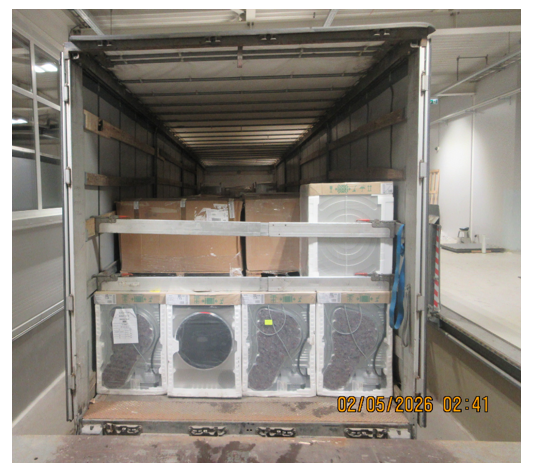
On 29 April, a suspected attempt to violate EU sanctions was prevented at the Terehova Customs Control Point. A freight vehicle operated by a carrier registered in Lithuania arrived heading towards Russia, and the driver submitted documents for customs control concerning goods (tumble dryers and their accessories) declared for export to Mongolia. A German company was indicated as the exporter in the customs declaration.
During the inspection, a second set of documents was found containing different information, including the recipient of the goods in Russia and a higher value of the goods. During an in-depth examination, torn documents bearing the carrier’s stamp were also found, and it was established that some of the declared goods were not actually present in the cargo compartment.
During the inspection, suspicions arose that the actual recipient of the goods was a Russian company, meaning that the EU export restrictions may apply to part of the consignment. The materials have been submitted for assessment of whether to initiate criminal proceedings.
FIU Latvia publishes a quarterly summary of the most significant sanctions developments and statistics to provide the public with regular and transparent information on the application and compliance with sanctions in Latvia. The summary has been prepared using information available to FIU Latvia, as well as data provided by the Prosecutor General’s Office, the Court Administration, and the Customs Board of the State Revenue Service.
2026-09-15
FIU Latvia at Kyiv Sanctions Forum: sanctions implementation is a collective effort at EU level
2026-08-14
Save the date: International sanctions conference in Riga to focus on measures degrading Russia’s war machine
